
Tirana’s mix of empires, ideology, and everyday life is exactly why this walking tour works so well. You start at the National Archaeologic Museum, then head into the city center for the big sights, including the Skanderbeg Square area and Tirana’s political history made physical.
What I like most is the combination of places you can see and stories you can actually connect, especially the glass of raki stop at the Pyramid of Tirana.
The one thing to plan for is pace. This is a 4-hour tour with about 3 hours of walking, and it is not suitable for people with mobility impairments, so comfortable shoes are not optional.
Key highlights you will actually feel on the ground
- Raki with the city view from the top of the Pyramid of Tirana
- Museum-first context at the National Archaeologic Museum before you walk the streets
- Italian-built boulevard details from the 1930s, plus where the capital power shows up
- Mosques and cathedrals in one route, so you understand religion through geography
- Blloku neighborhood history, from communist leadership area to bars and restaurants
- Skanderbeg Square storytelling, centered on Gjergj Kastrioti Skenderbeu and resistance to the Ottomans
A 4-hour walk that turns Tirana into a timeline you can follow
Tirana can feel like a city with layers, because it is. You see it in the architecture, you feel it in the street layout, and you hear it in the way local history is explained. This tour is built to help you connect those layers without getting lost in random stops. The route keeps moving, but it is not chaos. It is a guided storyline you can walk with your own feet.
The best part is that you are not just seeing famous buildings. You are learning how different periods shaped what you see today: Albanian resistance to the Ottomans, later communist rule under Enver Hoxha, and then the way Albania’s religious and political identities are expressed in public space. The tour also keeps things practical. It gives you a clear start point, a tight time frame, and a pace that works for most visitors who want the main hits in a half-day.
And the guide quality matters here. The experience has a strong reputation for clear explanations and lots of specific historical detail. In multiple reviews, guides named Nik or Nick and Beri are mentioned for making Albanian history easier to understand, and for keeping the hours moving fast.
More Walking Tours in Tirana
- Walking Tour of Tirana
★ 5.0 · 646 reviews - Tirana: Express Walking Tour with a Guide
★ 4.8 · 503 reviews - Tirana Center: Magic Walking Tour French/Italian/English Etc
★ 4.9 · 402 reviews
Starting at the National Archaeologic Museum, where your route makes sense
You meet in front of the Tirana National Archaeological Museum, and that is a smart move. Before you go street to street, the tour gives you a foundation. The museum stop is guided for about an hour, and it helps you frame what comes next in the city.
Why this matters: Tirana’s center can look like a collection of monuments unless someone gives you the timeline. With the museum first, the rest of the day stops feeling like disconnected photo ops. You start picking up references, names, and historical themes that your guide connects as you walk.
You also get the practical benefit of a structured start. Even if you arrive early or a little unsure, you are beginning with a clear anchor. The museum entrance fee is included, so there is no extra ticket math in the middle of your morning or afternoon.
The Italian-built boulevard and the Pyramid of Tirana viewpoint
After the museum context, you transition into the city’s main boulevard, a stretch described as constructed by Italians in the 1930s. That detail is not just trivia. It helps you understand why Tirana’s center feels the way it does, with certain wide lines and a modern-looking civic layout compared to what visitors might expect.
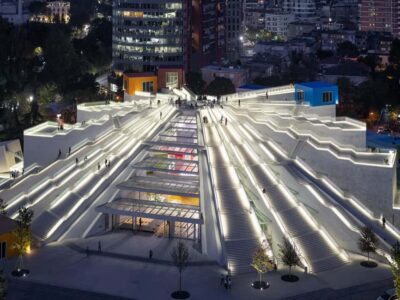
Then comes the Pyramid of Tirana, a stop that people remember for one reason: it is not treated like a random landmark. You visit it, and you learn how it was once a museum connected to Enver Hoxha. So even though you are standing in front of a concrete shape most cities have never heard of, you are learning why it became part of the communist story.
And yes, you get the payoff: a glass of raki at the top. The raki moment is small, but it changes the tone of the tour. You are no longer only absorbing history from a guide’s voice. You are also looking out from a high point and taking in the city’s layout with a local drink in hand.
If you do not drink, this is still a memorable stop because the tour frames the Pyramid’s political symbolism and its transformation over time. Just know that the included raki is part of the planned experience.
Tirana Castle, a quick stop that adds depth
The itinerary includes Tirana Castle, with a guided visit and a short walk. Castle stops can sometimes feel like short photo breaks, but here it works as a bridge between the central boulevards and the civic landmarks ahead.
Think of it as your chance to reset your perspective. Even without needing to hike for hours, you get a sense that Tirana’s story is not only modern institutions. There are older layers too, and the tour uses this stop to help you connect past and present.
If you like history that shows up in space, this is a worthwhile pause rather than a rushed checkpoint.
More walking tours of Tirana:
- Walking tour of Tirana
★ 4.8 · 285 reviews - Tirana Walking Tour
★ 4.8 · 209 reviews - Local food experience & walking tour of Tirana
★ 5.0 · 192 reviews - Tirana: Local food experience & walking tour
★ 5.0 · 154 reviews
Skanderbeg Square: the center of the national hero story
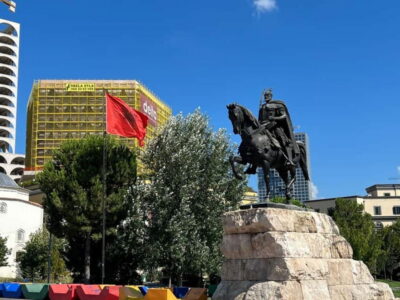
Skanderbeg Square is the kind of place that makes you understand why a city can feel proud. The tour takes you through the pedestrian area that leads to it, and it gives you a focused explanation around Gjergj Kastrioti Skenderbeu.
You learn the story of Albania’s resistance against the Ottomans in the 13th century, tied to the national hero’s name and legacy. The guide also points out how the square functions as a civic stage, so when you stand near the Skanderbeg statue, it lands differently than it would with no context.
What I like about this part of the day is how it balances big ideas with real geometry. You see the iconic center area, you get the hero story, and you also understand why these public spaces matter for how communities remember themselves.
Time-wise, you spend about an hour here with guidance and walking. That is long enough to slow down, take photos, and still move on before you get tired.
Catholic Cathedral, religions in Albania, and the Mother Teresa link
Next up is the Catholic Cathedral. This is not described as a detailed architectural lesson only. The tour uses the stop to explain religion in Albania, and it adds a personal, human connection through the story of Mother Teresa, who was Albanian.
For me, this is a good example of how a walking tour can avoid being only about monuments. The guide links a specific site to the bigger idea of religious presence in daily life, and then anchors it to a globally known figure with Albanian roots.
If you are the type who likes to understand a place beyond its postcard view, this stop is a strong one. It turns a building into a conversation about identity.
Et’hem Bey Mosque: Ottoman architecture you can spot fast
You also visit Et’hem Bey Mosque, a 16th-century mosque known for intricate frescoes and Ottoman architecture. The guided stop is part of the central loop around Skanderbeg Square and nearby historic areas.
The key here is that the tour does not treat the mosque as just another stop on a long list. It frames what to look for in a way that makes it easier to notice details in a short visit. You are not expected to become an architectural expert in 30 minutes. You just get enough direction to make the experience meaningful.
If you are sensitive to loud crowds or long indoor pauses, keep in mind that this is a guided city walk with multiple religious sites. You will be moving and listening more than you will be lingering silently. Still, it is a good mix, and it helps you see religious heritage in the same urban corridor.
The Orthodox Cathedral stop, and why the route feels balanced
The tour includes the Resurrection of Christ Orthodox Cathedral for a guided visit. Together with the Catholic Cathedral and the mosques, this makes the day feel intentionally balanced. You are seeing different religious traditions as part of one city’s fabric rather than treating each stop as a separate, unrelated landmark.
This is also where you start to understand the broader point the guide is likely making: Albania’s public identity is shaped by multiple traditions, and Tirana’s streets reflect that.
If you like walking routes that have a logic, this one does. It moves you through key civic and religious anchors without turning the day into a checklist.
Blloku: from communist leaders to bars, clubs, and restaurants
Then you shift into neighborhood history with a visit to Blloku. The tour frames it as the residence area of communist leaders, and it explains how the area changed after that era into a lively district with bars, clubs, and restaurants.
This stop is fun, but it is not just nightlife talk. The tour helps you understand why the neighborhood’s identity shifted and how history can leave physical and social marks on a place.
When you walk through Blloku with context, you notice the way the area’s current energy contrasts with its past purpose. It is a quick reality check that Tirana is not trapped in one era.
The walking time here is about an hour with guidance and movement through the area, so it is one of the more active blocks of the route.
Mother Teresa Square wrap-up: university views and a city ending point
The tour finishes around Mother Teresa Square, where you get some free time. You can admire the historic building of the university and also see the modern stadium nearby.
This ending makes sense. After a day full of religious sites, national hero storytelling, and political-era landmarks, you land back in a public square area that feels contemporary and civic. You also have room to pause, check photos, and grab a snack on your own if you want.
It is also a useful “last stop” for first-time visitors because you end in a recognizable hub, not on the edge of town.
Price and what feels like value at $38
At $38 per person for a 4-hour guided walk, you are paying for a lot more than a generic city tour. The price includes:
- a guided museum visit with entrance fee
- Pyramid of Tirana visit plus a glass of raki
- guided visits to multiple major religious sites
- guided walking through the historic center, including Skanderbeg Square and Blloku
So the value is in the combination. You get several focused stops that you might otherwise pay for separately or try to stitch together on your own with limited context.
If you enjoy history but hate spending your limited vacation time reading long plaques, the guided structure is the real bargain. It helps you turn stops into understanding. Guides like Nik or Nick and Beri are repeatedly praised for giving clear explanations and making the hours pass easily, and that is the difference between a good walk and a memorable one.
One note: meals are not included. If you want lunch or dinner, plan it around the tour time.
What about the walking, and how to prepare
This is not a sit-and-watch tour. It involves about 3 hours of walking. The tour is not suitable for people with mobility impairments, so be honest about your endurance.
Bring comfortable shoes. I would also suggest you dress for warm weather if you are going in a hot season, since city centers mean sun and concrete. A camera is recommended, and you will have plenty of photo moments: museum architecture, Skanderbeg Square, mosque and cathedral facades, and the viewpoint from the Pyramid.
Who this tour is best for
This tour is a great fit if you:
- want a first-time orientation to Tirana’s historic center
- like guided context that explains the “why” behind the “what”
- enjoy walking between major civic sites rather than taking lots of transit
- want a clear snapshot of Albania’s Ottoman resistance story and later communist period references
It may not be the best choice if you dislike walking for long stretches, or if you need accessible routes due to mobility limitations.
The vibe you should expect from the guide
The guide is the engine of the tour. The experience has a strong reputation for making Albanian history feel understandable, not overwhelming. Reviews highlight guides giving detailed insights, clear explanations, and keeping the pace smooth so the time feels like it flies.
You might also hear guide names like Nik or Nick, and Beri in different languages. The tour offers certified national tour guiding with languages listed as English, French, and Italian, so you can choose based on what you feel most comfortable following.
Should you book this Tirana walking tour?
Book it if you want a smart, story-driven half day that covers Tirana’s key landmarks with context. The museum first approach, the Pyramid of Tirana raki moment, and the route through Skanderbeg Square, multiple religious sites, and Blloku make it feel like you are seeing the city from several angles, not just one.
Skip it if you cannot do about 3 hours of walking, or if you prefer a fully self-paced tour where you control every stop.
If you like history explained in plain language, and you want Tirana’s main sights in one efficient loop, this is a strong value choice.
FAQ
How long is the Tirana walking tour?
The tour lasts 4 hours.
Is there a lot of walking?
Yes. The tour involves about 3 hours of walking.
Where do I meet the guide?
You meet in front of the Tirana National Archaeological Museum. The guide will be waiting with a sign reading Albaniaroadtrip.
What is included for the Pyramid of Tirana stop?
You visit the Pyramid of Tirana and you get a glass of raki on the top of the pyramid.
Which religious sites are visited?
The tour includes the Catholic Cathedral, a new mosque, Et’hem Bey Mosque, and the Resurrection of Christ Orthodox Cathedral.
Is the museum entrance fee included?
Yes. Entrance fee to the National Archeologic Museum is included.
What should I bring, and is it accessible?
Wear comfortable shoes and bring a camera for photos. It is not suitable for people with mobility impairments.
More Museums in Tirana
- From Tirana: Half-Day Kruja Trip and Skanderbeg Museum Entry
★ 4.7 · 41 reviews - Kruja, Old Bazaar, Museum,Sari Saltik tour from Tirana
★ 4.5 · 33 reviews - Kruja Castle, Museum & Bazaar Day Trip from Durres/Golem
★ 5.0 · 8 reviews - Kruja Castle, Museum & Bazaar Day Trip from Durres/Golem
★ 5.0 · 3 reviews
Newly listed around Tirana
- Private Day Tour of Saranda Gjirokaster,Butrint from Tirana★ 5.0 · 3 reviews
- From Tirana: Visit Prizren city and Kukesi lake★ 5.0 · 3 reviews
- Rafting And Swimming Adventure on the Black Drin River★ 5.0 · 3 reviews
- Private Transfer: Tirana Airport&City to/from Dhërmi★ 5.0 · 3 reviews
- 3 Hour Pub Crawl Tour in Tirana★ 3.5 · 3 reviews
- Tirana: Bovilla Lake & Gamti Mountain 4×4 Off-Road Tour★ 5.0 · 3 reviews
- Tirana/Durres: Saranda, Ksamil, Blue Eye & Vjosa River Tour★ 4.7 · 3 reviews
- From: Tirana and Shkoder: Theth & Blue Eye Full Day Tour.★ 5.0 · 3 reviews
Walking Tours, compared.
Tirana Center: Magic Walking Tour French/Italian/English Etc
Read our review →
Blue Eye Kayak and walking tour & Lekursi Castle
Read our review →

Browse the lists this tour appears in